
RFID Bulk Checkout vs Barcode Scanning: Which Is Better for Retail?
Retail checkout is changing. Customers want queues and accurate bills. Retailers need stock records and efficient staff workflows. For stores in Dubai, the UAE and KSA the choice between barcode scanning and RFID Bulk Checkout can affect customer satisfaction and overall performance.
Neither technology is the fit, for every business. Being knowledgeable on how these systems function, how expensive they are, and where the benefits lie assists retailers in making an informed decision.
How Barcode Checkout Works
Barcode systems help identify products by using printed labels that hold machine data. At the checkout counter an employee places each barcode label in front of a scanner. The point‑of‑sale software pulls the product description and price from the barcode. Then adds the product to the customer’s bill.
This familiar method is cheap and easy to fit into retail software. Barcode labels cost little and most cashiers already know how to use them.
Traditional checkout normally needs a separate scan, for each item. When a customer buys garments, accessories or boxed goods, staff must find every barcode label and scan each one by hand. If a label is damaged or hidden it can add waiting time.
What Is RFID Bulk Checkout?
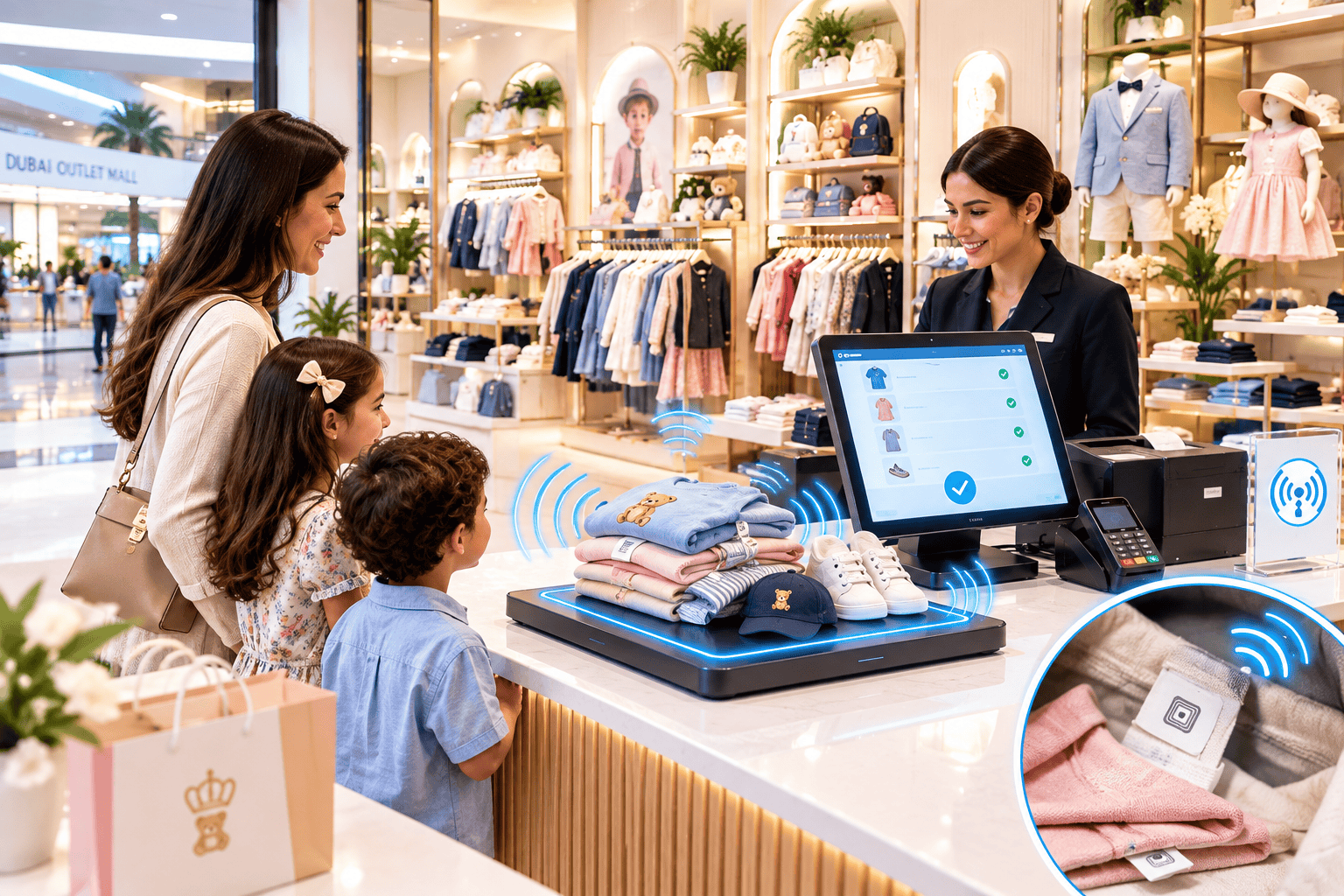
RFID Bulk Checkout uses radio frequency identification to spot tagged products inside a set reading area. Every item that takes part carries an RFID tag with its unique identifier. A reader and antenna set pick up those identifiers no need to see each label directly.
Checkout software pairs each identifier with its product record. Shows an itemised basket, for review. The cashier checks the selection, fixes any issues and finalises payment through the linked sales system.
RFID Bulk Checkout does not simply mean a scanner. RFID Bulk Checkout is a system that uses tags, readers, software, product data and carefully controlled reading zones.
Speed at the Checkout Counter
The biggest practical difference is how items are captured. With barcode checkout the process follows a step-by-step workflow: locate a barcode, scan it and then repeat for each item. RFID on the hand can detect several properly tagged products in one single reading operation.
For a fashion retailer handling baskets with items this difference can make a real impact. It reduces the need to handle each product repeatedly which leads to a faster transaction flow. During shopping times quicker item identification can help employees manage customer traffic more easily and reduce pressure.
Still the total time for a transaction depends on other factors. Payment processing, bagging, returns, promotions and staff routines all play a role. RFID doesn’t cut out these steps. It doesn’t guarantee a checkout speed either. It just helps with one part of the process—identifying items efficiently.
Accuracy and Transaction Control
These two types of technologies can help to conduct the sale process precisely. Barcode scanning is an intentional action and, therefore, makes it relatively easy to figure out which product was scanned by the system. Employees, however, may sometimes fail to notice the product at all or scan the wrong label.
The RFID technology does not require additional scanning and eliminates the issue of manual duplication. At the same time, there will be different problems related to the use of the radio frequency technology. The reading zone should be well-placed to avoid recognizing some products that were not chosen by the customer.
RFID Retail Inventory Tracking Beyond Checkout
The ability to use RFID beyond the cash register is an interesting feature of RFID technology. RFID Retail Inventory Tracking can facilitate receiving, inventory counting, reordering, shipping, and searching for products using compatible handheld scanners and software.
Since tagged items can be tracked individually, it is possible that retailers will get better insights into the flow of merchandise and stock discrepancies. Frequent cycle counting can also be considered as a method to ascertain availability and replenishment needs.
Barcode technology also helps in managing inventories; however, it usually requires employees to manually find and scan codes during the physical count process.
Comparing Implementation Costs
The bar code system has always been more economical to use initially. The label printers, readers, and existing POS interfaces are easily accessible. This means that bar codes would be suitable for small retail stores, cheap goods, and companies with low volume transactions.
RFID technology would involve extra expenditure on buying the right tag, the reader device, antenna, software interface, testing, and training of personnel. Companies need to account for tagging cost and maintenance as well.
Apart from considering the price of equipment, the operating cost of labor involved in the process should also be considered.
Which Retailers Benefit Most?
RFID Bulk Checkout should be examined in depth for apparel and accessories retail chains where numerous tagged items get sold in one checkout. Companies with large inventories can achieve greater benefits through employing the same identification system for inventory purposes.
Barcode checkout is feasible for convenience stores, businesses dealing with very inexpensive merchandise or retailers whose current scanning technology satisfies customers’ requirements.
Sometimes it makes sense to use both systems together. The barcodes can be employed for non-RFID marked items, returns, supplier’s labels, and other special situations, while the RFID system works with suitable merchandise in bulk.
Considerations for Retailers in KSA
As retail businesses in KSA continue to grow in number, there is an increasing need for a system that links brick-and-mortar stores to inventory databases and checkout operations. In order to conduct a test before implementation of RFID, there needs to be an evaluation of product types, tagging issues, integration with POS, infrastructure preparedness, and training of employees.
The test environment should be set up to simulate peak checkout time, product diversity in the basket, stocked products, difficult-to-tag products, as well as local radio standards and privacy regulations.
How ACUBE Infotech Can Help
ACUBE Infotech is able to offer services related to RFID solutions when a retail company decides to explore more efficient checkouts and inventory processes. The appropriate project would consist of merchandise assessment, RFID tags selection, configuring the readers and software, testing and advice about operation.
A proper recommendation depends on transaction volume, merchandise type, current systems and budget. Acube Infotech can assist companies to estimate how their barcode processing compares to RFID-enabled solutions.
A barcode scan works well for identifying products in an affordable manner. Those who wish to identify multiple items more quickly can look into RFID Bulk Checkout for consideration. The most ideal option will be the one that enhances the store’s performance.