
RFID Asset Tracking App Implementation: A Complete Guide for Companies
Nowadays, businesses that continue to lose sight of their assets, are simply inviting their downfall. When it comes to the different types of assets such as equipment, tools, IT devices, and returnable assets, the question of where assets are, how asset usage is being done, and who the asset custodian is, is quite paramount in terms of operational efficiency and cost control. This is what a RFID Asset Tracking App can accomplish for you.
Acube Infotech is a partner that has helped several organizations across various industries to leverage intelligent RFID-based solutions that ensure the identification of assets in real-time, tracking without human intervention, and provision of actionable insights. This book is an overview of what companies need to know about RFID Asset Tracking App, everything from the basics to the best practices.
What Is an RFID Asset Tracking App?
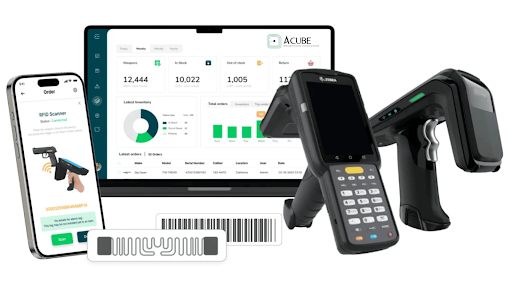
An RFID Asset Tracking App is a software program that uses RFID technology to find see where and manage items. In this system a small RFID tag is placed on each item that sends out signals to RFID readers. This information is then. Shown through an Asset Tracking App, which shows up-to-date details and one place to control everything.
Traditional tracking systems like barcodes or manual methods cannot offer the advantages that RFID can bring:
- Scanning with no line of sight requirement
- Quicker identification of assets
- Reading of multiple assets simultaneously
- Greatly improved accuracy with reduced human input
Thus, it is a much more efficient and dependable way of handling assets across different locations.
Why Companies Are Adopting RFID Asset Tracking Apps
Companies, in manufacturing, healthcare, logistics, hospitality, retail and corporate sectors are quickly using RFID Asset Tracking Apps to take advantage of these benefits::
1. Real-Time Asset Visibility
With the help of RFID, assets can be located instantaneously when they are transferred from one facility, department, or site to another. The decision-makers among the executives are informed at all times about the asset’s whereabouts and condition.
2. Reduced Asset Loss and Theft
Use of automated tracking has led to a drastic reduction in losses through theft or misplacement of assets and the method has thus fostered accountability as well as the state of being ready for an audit.
3. Improved Operational Efficiency
Manual asset verification is replaced by automated scanning which in turn saves labor hours and work-related expenses.
4. Accurate Asset Data
Use of RFID technology completely removes the probability of errors made by humans when writing data in spreadsheets or manually entering it.
5. Better Asset Utilization
Features of the Asset Tracking App allow enterprises to find out which of their equipment is not being used to its full potential or is overused.
Key Components of an RFID Asset Tracking App Solution
A successful RFID Asset Tracking App implementation is composed of several components that are well integrated:
RFID Tags
Tags are the component that physically sticks to the assets and carries the identification data that is unique. They may be passive, active, or semi-active depending on the nature of the tracking.
RFID Readers
Readers are devices used to gather data from tags. Types of readers could be handheld, fixed readers, or gate antennae.
Asset Tracking App
The Asset Tracking App serves as the user interface which provides the display of asset location, movement history, status, and reports.
Backend System
The data processed and stored safely in the system is collected from various assets. The backend is composed of databases, servers, and analytics.
Integration Layer
Workflows run effortlessly when the integration layer connects the ERP system, CMMS software systems, or inventory management software systems.
Step-by-Step RFID Asset Tracking App Implementation Guide
Step 1: Asset Identification and Assessment
First decide which assets you will manage. Separate those assets by their worth, how easy they are to move and how often you use them. Whether those assets need to follow any rules or regulations.
Step 2: Define Business Objectives
Be clear about what you want to reach with Business Objectives. For example one main business objective can be preventing loss.
- Preventing loss
- Auditing via automation
- Maintenance scheduling
- Optimizing utilization
Having objectives helps you create a good RFID Asset Tracking App plan.
Step 3: Choose RFID Technology.
Pick the RFID tags and readers by looking at:
- Type of asset (metal, liquid, equipment)
- Whether the environment is indoor or outdoor
- Requirements of the reading distance
- Amount of data needed to be transmitted
We at Acube Infotech, perform site surveys to help technology selection be spot on.
Step 4: Asset Tagging
Every asset gets a tag and the detail is digitally linked within the Asset Tracking App.
Step 5: App Configuration and Customization
The application is tailored to your business needs and can be used to perform the following functions:
- Asset Categories
- User Roles
- Location Hierarchy
- Alerts & Notifications
- Reporting Dashboards
Step 6: System Integration
Connect with current business applications, such as ERP, Finance, and/or Maintenance, in an end-to-end transparent way with Asset Tracking Application.
Step 7: Step 7: Testing and Validation
Run a pilot test to confirm reading accuracy, app performance and data synchronization before deployment.
Step 8: Training and Go-Live
We will teach the employees how to use the Asset Tracking App. After validation, the system is introduced across the entire organization.
Common Challenges and How to Overcome Them
Signal Interference
Metal and liquid environments have a negative impact on RFID performance. The use of special tags and correct reader positioning can overcome this problem.
Change Management
The staff may resist new technology at first. Through effective training and communication, the employees get familiar with the new technology faster.
Data Accuracy
Errors in the first tagging can impact the results.A well-regulated system of tagging and confirmation is required to ensure the accuracy of the tasks.
Scalability
The RFID Asset Tracking App must be scalable to handle future growth of the business, new assets, and more locations.
Best Practices for RFID Asset Tracking App Success
- Make an in-depth site survey before implementation
- Pick industrial-grade RFID tags for tough wear and tear
- Don’t forget to add role-based access in the asset tracking app
- Plan system audits regularly
- Run analytics and reports to empower continuous improvement
Industries Benefiting from RFID Asset Tracking Apps
- Manufacturing: Manufacturing tools, machinery production assets are vital for every factory.
- Healthcare: Healthcare equipment, devices and wheelchairs are essential for care.
- Hospitality: Hospitality furniture, linen and operational assets keep guests
- Logistics & Warehousing: Logistics & Warehousing pallets, containers, material handling equipment move goods smoothly.
- Corporate Offices: IT assets, laptops, AV equipment
Why Choose Acube Infotech for RFID Asset Tracking App Implementation?
Acube Infotech is your reliable partner for complete turnkey RFID Asset Tracking App solutions that can be custom made for your business. We provide the following range of services:
- RFID, consulting, and designing of solutions
- Asset tagging and physical verification
- Development of custom Asset Tracking App
- Ensuring system integration without any disruption
- Continuous support and reengineering
We have consolidated our experiences inside and outside the UAE to offer you a reign transformation from manual asset management to digital asset management.
Final Thoughts
An RFID Asset Tracking App implementation cannot just be seen as a luxury anymore, it has become a strategic necessity for companies that wish to have their assets transparent, efficiently managed and controlled. By using the correct method, technology and getting a good implementation partner, companies can realize the value of their operations in the long run.
If you want to bring your asset management process up to date, Acube Infotech will be more than happy to assist you in all of the steps.