
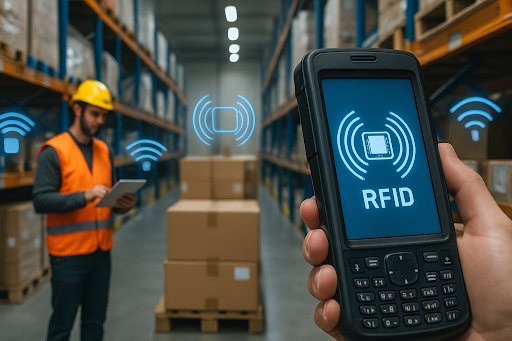
How does RFID Tagging system work
In the fast moving and digital world of today, businesses are continuously looking for ways to increase their effectiveness, lower costs, and keep an accurate record of their assets. One of the most powerful solutions is the RFID Tagging System, which has revolutionized the usage of several industries such as retail, healthcare, logistics, aviation and manufacturing.
We at Acube Infotech, are extremely capable of delivering the most innovative asset tagging solutions that are powered by RFID technology. Our goal is to enable organizations to simplify their operations and manage their assets in a better way.
What is RFID?
RFID (Radio Frequency Identification) is a system that communicates the details of, keeps records of and manages, without the need for human intervention, the use of radio waves. Contrary to conventional barcodes which not only have to be seen but also have to be scanned, with the use of RFID, information can be extracted wirelessly even from the tags hidden in the middle of the paperwork.
Usually, an RFID tagging solutions includes three components:
- RFID Tags – Miniature gadgets that hold the information of the asset in question.
- RFID Readers – Instruments that interact with the tags by sending the signals and thus getting the information.
- Software System – A front end that makes the collected data available for tracking, reporting, and analytics.
How Does the RFID Tagging System Work?
1. Tagging the Asset
An RFID tag is attached to each item or asset. RFID tags contain a microchip and an antenna so RFID tags can wirelessly transmit the data they store when an RFID reader activates them.
2. Signal Transmission
When an RFID reader sends out a radio signal the signal reaches every tag thats nearby. The tags that are close enough receive the signal. Get activated. The tag answers by sending back the reader its unique identification number and other data that are stored.
3. Data Collection
The data that is sent is collected by the RFID reader and after that, it is sent to a central database or a cloud software system.
4. Data Processing and Visibility
The software gets the information and provides the exact location, the condition, and the change of each identified object. The companies are allowed to oversee, organize, and regulate their resources in a better way.
This efficient system simplifies the work of the staff, eliminates the risk of mistakes, and also makes the whole process much faster, which is very important in the supply chain where accurate asset tracking is needed.
Key Benefits of RFID Tagging
Implementing an RFID tagging offers several benefits that significantly outrank the traditional methods of asset management:
- Real Time Asset Tracking : You can find out the exact location of your assets within seconds, it doesn’t matter whether they are stationed in a warehouse, hospital, airport, or retail store.
- Enhanced Accuracy : The use of RFID technology significantly decreases the error rate, which is the major cause of human mistakes, in tracking compared to manual or barcode-based systems.
- Improved Efficiency : The process of taking inventory can be done at a much faster rate with RFID technology. A task that would normally require several hours to be done manually can be achieved instead in a very short time.
- Theft Prevention and Security : For instance, suppose a valuable object is moved to a place that is not authorized, then the alert system can immediately send a message notifying the owners of the event. In this way, the occurrence of theft and loss can be minimized significantly in the area.
- Scalability : RFID systems are able to manage thousands of tags at the same time and therefore they are very suitable for operations of a big size.
- Cost Savings : An RFID system will provide a company with a lot of money in the long run as it will decrease the error rate, labor time, and losses.
Types of RFID Tags Used in Asset Tagging
The common kinds of RFID tags are:
- Passive RFID Tags
- No batteries, the reader’s signal activates the tags.
- Small size and low cost.
- They are ideal for the retail sector and the basic management of assets.
- Active RFID Tags
- By an internal battery, they are powered.
- The signals can be sent a very long distance from the tag.
- The most suitable way is for the efficient tracking of logistics and aviation.
- Specialized Tags
- Metal mount labels that are used for industrial machines.
- Labels that are resistant to heat and used in manufacturing settings.
- Wearable labels that are made of flexible materials such as fabric and other textile products.
Applications of RFID Tagging
RFID does not only apply to one sector but it is used in different sectors such as:
- Retail: Real time stock management which is not only more efficient but also more reliable, anti theft systems, and customer checkout processes that have been made much easier.
- Healthcare: The management of medical instruments, the upkeep of patient records and the delivery of drugs all through the use of RFID technology.
- Logistics & Supply Chain: Implementation of RFID technology in freight shipping can give the elimination of mistakes as a result along with the optimization of the storage operations.
- Airports: The identification and the tracking of the luggage, the monitoring of the air cargo and the security checks of the passengers and their belongings.
- Manufacturing: The tracking of the work in progress, the monitoring of the equipment and the quality assurance.
- Corporate Offices: Asset tagging solutions are implemented for IT equipment, furniture and documentation.
Asset Tagging Services of Acube Infotech
Acube Infotech has the most complete asset tagging services that utilize RFID technology to enable the solution. Our solutions have the flexibility to cater to the needs of businesses in any sector, thus making sure that assets are not only tracked but also managed and secured.
With Acube Infotech, businesses gain not just a technology partner but a long term collaborator in building efficient and future ready asset management systems.
Conclusion
RFID Tagging is revolutionizing the way companies manage their assets, giving them the opportunity to save time, increase their accuracy, and have a real-time visibility of their assets. The usage of RFID in various sectors such as that of logistics is leading to the facility of the world being smart and efficient.
We at Acube Infotech, with our professional asset tagging services, make it possible for the organizations to use the RFID technology to its fullest extent. The solutions we offer are meant to bring you tangible outcomes, be it that you want to keep a record of your inventory, provide security for assets of high value, or maintain the smooth running of operations.
As different industries are making use of digital transformation, it is certain that the role of RFID will be a very important one for the department of asset management and the overall business success. Become our partner at Acube Infotech today and make your first move towards more intelligent asset tagging solutions.